“A longer life would mean very little if we failed to experience it.” Dāvis Sīmanis on Death of Death
We spoke to director Dāvis Sīmanis about Death of Death, and his journey through the world of transhumanists, cryonics and longevity science. Drawing on ten years of material, the film travels from the Coffin Bus at Capitol Hill to a cryonics facility near Moscow, exploring the question of immortality, which tows the line between science and consumer experience.
In this interview, Sīmanis discusses making a film whose subject kept moving ahead of him as AI and longevity science evolved, and leaves the viewers with a sense that the story will continue beyond the film. Along the way he contemplates what we do with the time we already have.
Death of Death will have a special screening on 2 November, All Souls’ Day. It is part of our KineDok collection and can be seen at several fascinating venues. Check out the current programme here.
For most of the film’s running time, long and static shots showing nature or objects are held on screen for a long time. Was the slowness a deliberate balance to the urgency of the people on screen? What do you hope the viewer takes away from these shots?
Yes, the slowness was deliberate. It creates a contrast with the urgency of the transhumanists, who seem to be racing against their own biological clocks. They want to accelerate progress enough to reach immortality within their lifetimes. The landscapes introduce a different experience of time. They will outlive us, and their duration makes our individual lives seem very brief. For me, nature offers the most tangible image of longevity in the film. I hope these shots give viewers time to feel their own presence within that larger timescale, and to consider what it means to spend so much of our limited time imagining how we might escape its limits.
You link several different themes together in the film, such as the pursuit of immortality and the glorification of death in Russian society. How did these ideas come together for you, and how did you make their connection clear to viewers?
I believe every thought about immortality also contains a thought about death. The desire to live forever is inseparable from our fear of disappearing, so these themes were connected for me from the beginning. The film moves between different ways of responding to that fear, including the attempt to overcome death and the impulse to glorify it.
In the Russian context, this connection becomes particularly disturbing. The coexistence of dreams of immortality and the destruction of human life in Russia’s war against Ukraine exposes a tragic absurdity. How can a society entertain the promise of endless life while its regime treats actual human lives as expendable? The longing to preserve one’s own existence becomes grotesque beside the willingness to destroy someone else’s. I tried to make that contradiction visible through the juxtaposition of the material, allowing viewers to encounter these ideas together. The connection is both philosophical and painfully concrete: the same world that imagines defeating death continues to produce it on a devastating scale.
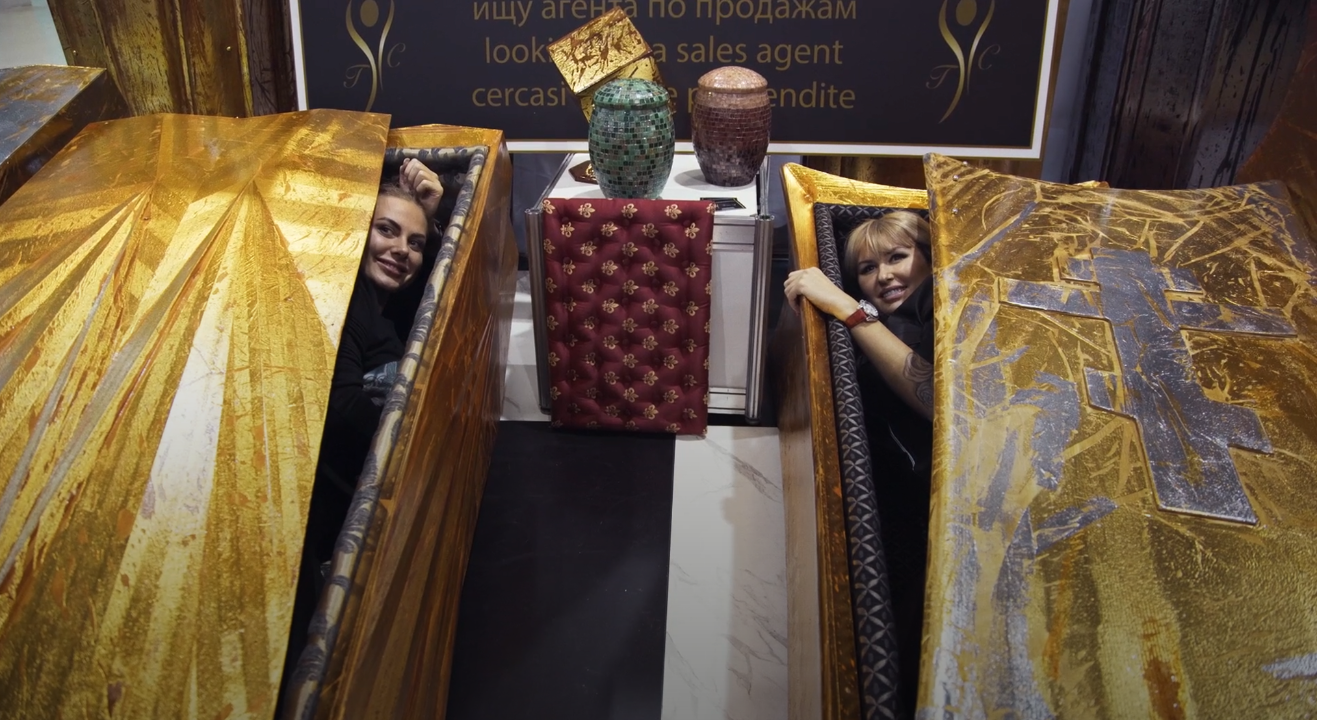
The sequences filmed in Russia show funeral fashion shows, luxurious coffins and people taking selfies in them. Is the film partly about coming to terms with mortality once we accept that immortality may remain out of reach?
No, that is not my main reading of those sequences. For me, they reveal an obsession with death in Russia, where it can become a spectacle or even a consumer experience. The luxurious coffins and the selfies are disturbing in the context of a dictatorship that places so little value on human life. There is something grotesque about lavishing such attention on the presentation of death while accepting the destruction of living people.
Of course, the film also searches for ways to face our own mortality. That question runs through the whole journey, including my voice-over. But I would hesitate to interpret the Russian scenes as a form of reconciliation with death. I see them as revealing a culture in which death is displayed and celebrated, while living people are treated as disposable.
You film a cryonics facility near Moscow that stores hibernated people in ‘insulated vats.’ Did you struggle with ethical questions when making this film, particularly with this facility?
For me, the central ethical responsibility lies with those who offer this service and with those who choose to participate in it. The providers need to be clear about what they are offering and what remains a hope for the future. People who entrust their bodies, or those of their loved ones, to cryopreservation are making a decision shaped by their desire for more life. As a filmmaker, my responsibility is to make that situation visible and allow viewers to reflect on the relationship between hope, personal choice and a business built around the fear of death.
Death is one of the few things that has always equalised people. What do you think happens to a society when that stops being true, when some people can buy more time and everyone else cannot?
We already live with a version of that inequality. Access to medicine and advanced treatments is profoundly uneven, so wealth can already influence how much time a person has. Death may be universal, but the conditions under which we approach it are far from equal.
If life extension becomes much more substantial and remains available only to a privileged minority, I believe that inequality will provoke serious social conflict, perhaps even revolt. People would be confronting the possibility that others can purchase decades of life that they themselves will never be able to afford. That would affect how they understand justice and their place in society. It would also force us to ask who has the right to benefit from scientific progress. The social consequences of longevity could become as difficult to address as the scientific challenge itself.
How did you meet Zoltan Istvan, the man who brought the Transhumanist Bill of Rights to Capitol Hill? Did your interview with him convince you that this topic was big enough for a feature-length documentary?
I think there is enough in this subject for many documentaries. The question of immortality reaches into science, but also into our political and private lives. It asks us to reconsider something we usually regard as inevitable. Zoltan’s enthusiasm is contagious. When he speaks about his ideas, you can feel how completely he believes that the future he imagines is within reach. Even when you remain uncertain about the promise itself, you begin to understand why someone would devote his life to it.
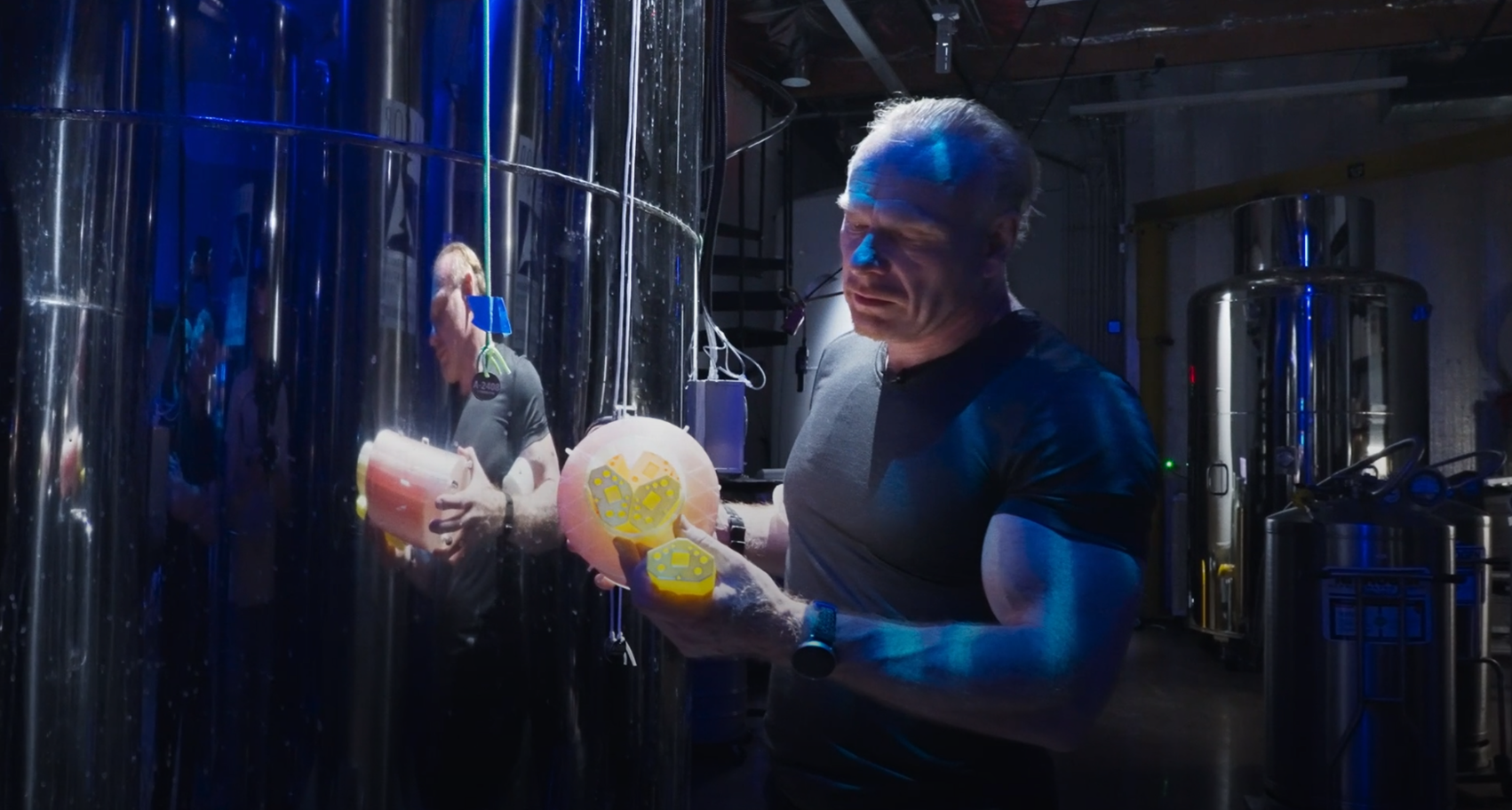
We approached him after learning that he was running for president of the United States as a candidate of the Transhumanist Party. We met him at his vineyards in Napa Valley, where he was planning to create a wine associated with longevity. The setting itself was revealing: the ambition to overcome death had entered something as familiar as winemaking. For the film, that enthusiasm mattered because it gave a face and a voice to an idea that can otherwise seem very abstract.
Were any interviews or storylines left out of the final cut? How did you decide what to leave out, and what not?
Yes, a couple of characters were left out of the final film. The guiding principle was the progression of the journey. I wanted to move gradually from idealistic futurists and transhumanists towards scientists who are working on longevity and believe in the possibility of extending life.
That movement allows viewers to encounter the dream of immortality before considering how it relates to scientific work. The editing decisions depended on what each character contributed to that progression. An interview could be interesting in itself and still take the film away from the questions it was developing. The final structure needed to give those questions room to deepen without becoming an exhaustive catalogue of everyone involved in the field.
How did the long development and fast pace of AI evolution affect your story or change the film you had originally set out to make? How did you decide when to stop filming, given that the technology kept changing after the cameras stopped?
I believe we would make a completely different film if we started now. During such a long development period, the context keeps changing, and AI is perhaps the clearest example of that. New treatments and different approaches to longevity also continually alter what people think might be possible.
This pace of change made it increasingly clear that a definitive account of how far longevity science had progressed would be difficult to sustain. Any apparent conclusion could become outdated while we were still editing. We therefore placed more emphasis on people’s longings and their dreams of immortality, as well as my own reflections on death and the possibility of living indefinitely. Those desires persist even as the technologies around them change.
That also gave us a way to finish the film. There could never be a final technological development after which nothing more needed to be filmed. We had to find a point at which the journey through these questions could stand on its own and still leave the future open. The film’s completion could not depend on science reaching a conclusion. It depended on giving a form to our encounter with people who hope to escape death, and to the uncertainty that remained after listening to them.
Death of Death has a long history with the Institute of Documentary Film. It took part in the East Doc Forum in 2021, followed by Czech Docs: Coming Soon and the East Doc Market in 2025. Now it is part of our KineDok collection. How did these activities help the film at different stages of its development?
We have had a strong partnership with our Czech colleagues for many years, and these activities gave that collaboration a broader international reach. The earlier forums offered an opportunity to introduce the project while its shape was still emerging. The later presentations brought attention to a film that was approaching completion.
For a documentary developed over such a long period, that continuity matters. It helps the project remain visible as it moves towards completion. The forums you mention formed part of that process of international exposure, which continued with the film’s premiere at the Ji.hlava International Documentary Film Festival. They connected different stages of a journey that, from our side, lasted many years.
After ten years with this material, what has Death of Death taught you about the value of time, and how has your attitude toward immortality changed?
It has been an immense lesson in the value of every moment. Spending so many years with people who want more time made me think more carefully about how I inhabit the time I already have. I feel that something loses its meaning if I am only trying to reach an outcome and am not fully living through the experience itself.
What matters to me is whether that experience allows me to learn, feel something or encounter the world differently. My attention has shifted towards the quality of being alive. The possibility of endless time remains fascinating, but it has also made the present feel more consequential. A longer life would mean very little if we failed to experience it.
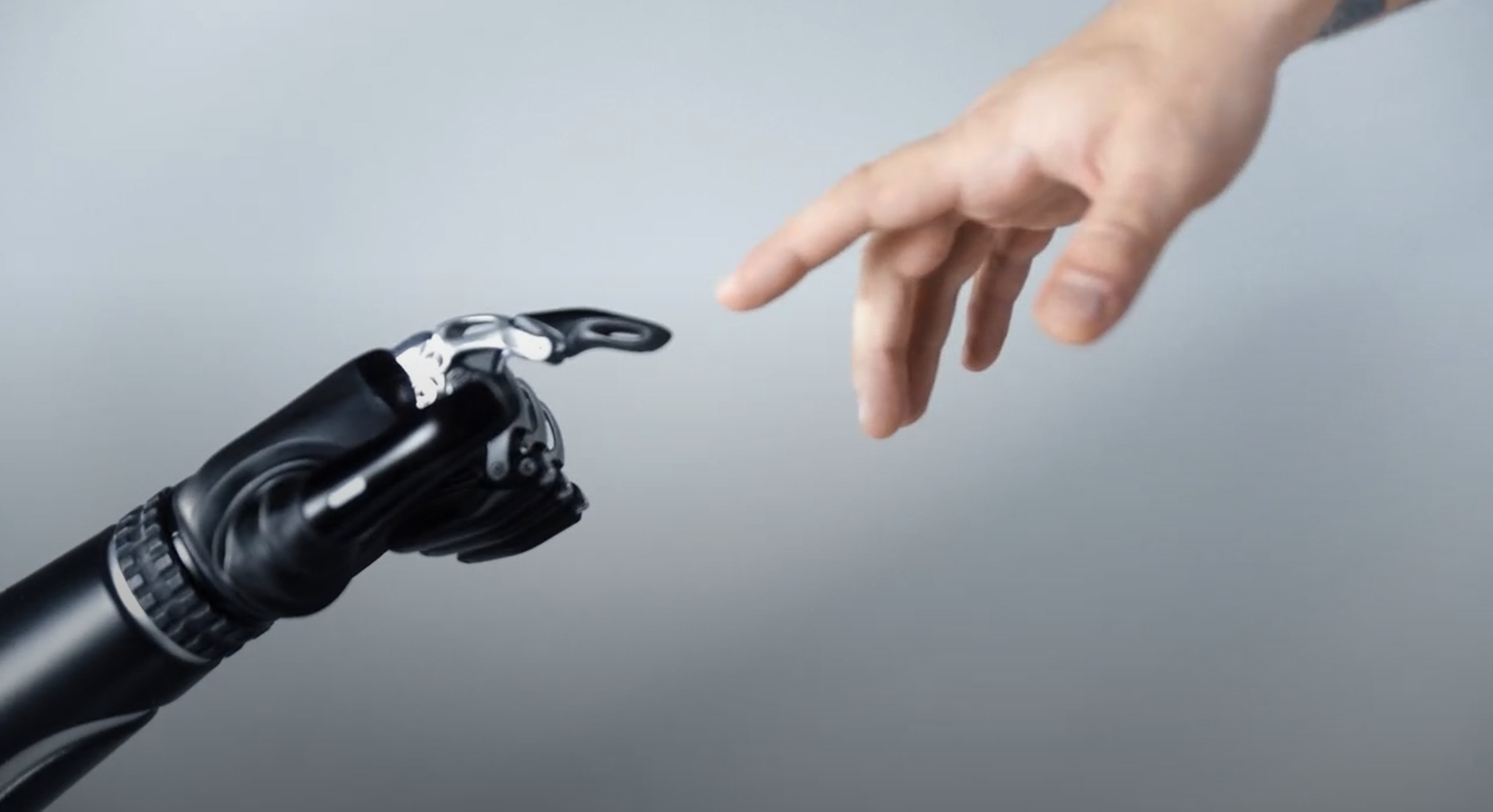
The final line of the film points to AI evolution with an unsettling, almost cliffhanger effect. Do you believe the transhumanist movement will progress with AI, either by finding a cure for death or by making a digital backup of the mind, or is the ending intended to be thought-provoking, as people continue to pursue an impossibility?
As a filmmaker, I intended it as an open ending that allows for different possible futures. The film could hardly close with a definitive answer to a question that continues to change. I wanted that final reference to AI to leave viewers with the sense that the story will continue beyond the film, and that its next direction could be unsettling.
Speaking simply as a person, I would put it more bluntly: if AI does not kill us in the next decade, I believe it will help us develop better treatments and more sustainable ways of extending life. That is a hope, expressed with some irony, and it does not resolve the question of immortality. A digital backup of the mind also raises another question: what would it mean for such a copy to continue someone’s existence? The ending leaves room for viewers to think about those possibilities. I cannot say whether death will ever be overcome, but I believe the attempt to overcome it will continue, bringing new uncertainties with it.
Your voice-over admits you are not sure what the film is about. Do you hope that the viewers, who possibly think about transhumanism and the pursuit of immortality for the first time, will decide that for themselves?
Yes. I hope the film provides an initial spark, especially for people who rarely think about their own death. There is something peculiar about modern life: we can organise our days as though mortality were absent, even though it shapes the limits of everything we do. Encountering people who are determined to live forever can make that absence suddenly visible.
My uncertainty in the voice-over leaves room for viewers to reflect on their own lives and decide which questions matter most to them. I would like the film to prompt them to consider what gives their time value, and what they would actually want to preserve if they could live much longer.
I also hope they carry that reflection towards the tragedy of war. Against all these efforts to prolong existence, war appears as a catastrophic and anachronistic destruction of life. The question of how long we might live becomes inseparable from the question of how we treat living people. That connection is something I hope viewers will continue thinking about after the film.
Interview by: Rozália Berkó
More Articles by topic KineDok interviews
“A longer life would mean very little if we failed to experience it.” Dāvis Sīmanis on Death of Death
“I like it when a film emotionally bombards me.” Miro Remo on Better Go Mad in the Wild

Queerness and communism
We live the documentary film, be there with us.
Start each month with a fresh dose of information. Subscribe to the newsletter.
I hereby consent to the processing of the personal data.

Organizer

Screenings
KineDok Venues